Choosing an agent
Each session is driven by one agent model, which you pick when you start it. The model locks once the session begins, so choose it up front — different sessions can run on different models.
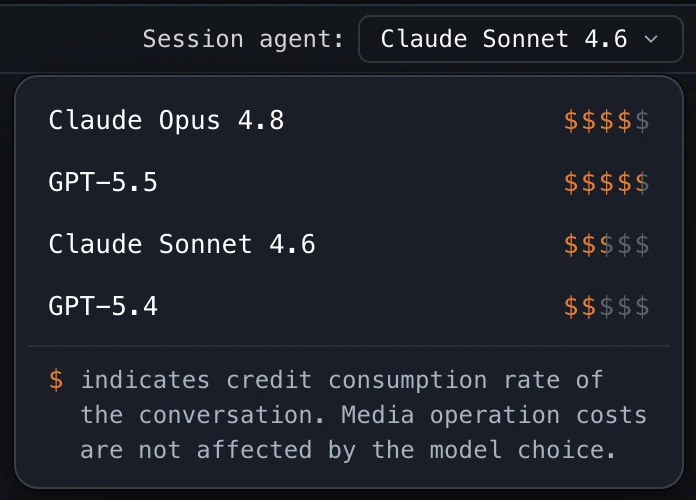
Which model to pick#
Lighter models are quick and economical, and a fine default for simple, one-shot tasks. Heavier models are stronger at multi-step orchestration: planning a production, chaining many tools, and holding a long thread together. When a job has lots of moving parts, the stronger model usually pays for itself in fewer detours.
What the model affects#
Your choice sets the credit rate of the conversation — the agent's reasoning and back-and-forth. It does not change what media operations cost: a generation, edit, or enhancement is priced the same whatever model you're chatting with. So a heavier model costs more only for the thinking, not for the media it produces.
Setting a default#
Every new session opens with a model already selected, so you're not choosing from scratch each time. You can change which model is selected by default under Settings → Model → Default model. It only seeds the choice — you can still switch to a different model for any session before its first message, after which it locks as usual.
Leave the default on Auto and new sessions follow our recommended model for the moment, so you get a sensible pick without thinking about it. Choose a specific model instead and every new session starts on it.